Start Small: Build One Module That Works
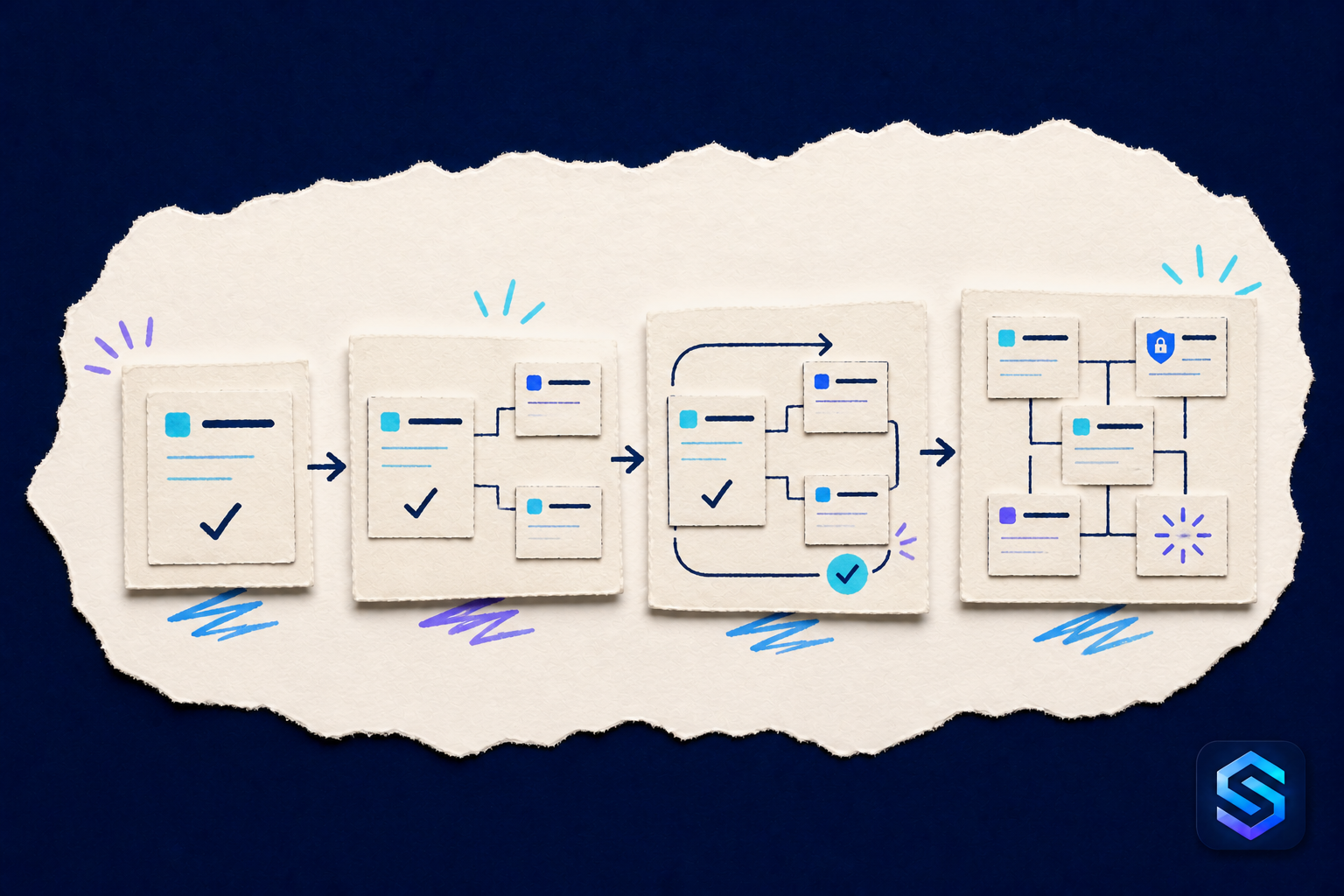
When businesses begin planning a new management system, ambition can quickly create complexity.
You start with one requirement, such as managing invoices. Then you realize that invoices need customers. Customers have contacts. Invoices contain products. Products affect inventory. Inventory involves suppliers, purchasing, and warehouses.
Before long, one idea has become ten modules—and none of them is finished.
SineCodex is designed to support connected business information, but that does not mean you should build everything at once.
The strongest systems often begin with one clearly defined requirement.
Begin with the Business Need
Before thinking about fields, forms, or automation, decide what the business needs to manage.
Do you need to keep track of customers?
Do you need to manage materials or inventory?
Do you need to record employee time?
Do you need to prepare invoices?
Choose one important responsibility and make it the focus of your first module.
The objective should be easy to explain in one sentence:
This module manages our projects.
Or:
This module records the time worked by our employees.
If the sentence requires several unrelated responsibilities joined by “and,” the module may be trying to do too much.
Define the Information That Belongs There
Once the purpose is clear, think about the information required to support it.
A customer module may need a name, contact information, status, preferred language, and other details that describe the customer.
A project module may need a title, description, start date, expected completion date, status, and project manager.
An inventory item may need a part number, description, quantity, location, and reorder level.
Every field should help the module fulfil its primary responsibility.
This is an important discipline. It is easy to add fields simply because the information might be useful someday. But unnecessary fields make forms longer, confuse users, and make the purpose of the module less clear.
Start with the information you need for the process you are implementing now.
You can always improve the module later.
One Module Should Represent One Thing
A module should have one clear identity.
A project module manages projects. It should not also become the place where every task, employee, material, time entry, and invoice is stored.
Those elements are related to the project, but they are not the project itself.
If projects contain tasks, create a task module and connect each task to its project.
If employees record their time, create a time-entry module and connect each entry to the employee, task, or project involved.
If materials are used on a project, record that usage in an appropriate module and connect it to both the project and the inventory item.
Each module manages one type of record. Connections describe how those records work together.
This keeps the structure understandable as the system grows.
Supporting Modules Are Part of the Design
Focusing on one requirement does not always mean building only one module.
Some features naturally depend on supporting information.
An invoicing module needs to know which customer receives the invoice. It may also need invoice lines connected to products or services.
An inventory workflow may require a module for parts and another for locations.
A time-entry module needs employees and may also connect to projects or tasks.
These supporting modules are not separate projects competing for attention. They are the smallest set of building blocks required to make the main feature work properly.
The difference is focus.
You are not trying to complete your entire business-management system. You are building one useful workflow and only the supporting modules that workflow genuinely requires.
Do Not Build Ten Modules at Once
Planning ten interconnected modules before validating the first workflow creates a great deal of uncertainty.
A decision made in one module may affect several others. A field may be added before anyone knows whether it is useful. Connections can be created around assumptions that have never been tested during real work.
The structure becomes increasingly difficult to change because everything appears to depend on everything else.
Instead, complete one feature.
Use it. Test it. Let the people who perform the work provide feedback. Confirm that the fields make sense, the connections are useful, and the process reflects what actually happens in the business.
Once the result works well, move to the next requirement.
The knowledge gained from the first module will improve the design of the second.
Smaller Modules Create Clearer Access
Separating business concepts also makes access easier to control.
Consider employees and time entries.
Many users may need to create or review time entries. That does not mean they should all have access to private employee records.
When employee management and time tracking are separate modules, each can have permissions appropriate to its purpose. A small group may manage employee information, while a larger group can record time through controlled connections.
If everything were stored in one large module, protecting sensitive information would become much more difficult.
Clear module boundaries create clearer security boundaries.
Connections Make the System Smarter
A small module may appear simple on its own. Its value grows when it is connected to other well-designed modules.
A task connects to a project. A time entry connects to a task and an employee. An invoice connects to a customer. An invoice line connects to a product or service.
These connections allow information to move through the system without placing every responsibility in the same location.
They also create opportunities for automation.
A completed task may update a project. Approved time entries may contribute to an invoice. Inventory usage may adjust available quantities. Customer activity may help a sales or support team understand the relationship.
The system becomes more capable because its modules cooperate—not because one enormous module attempts to do everything.
Build, Learn, and Expand
SineCodex lets a business create modules that reflect how it actually operates. That flexibility is most valuable when it is used gradually and deliberately.
Start with one need.
Define one clear responsibility.
Add only the fields required to support it.
Create the few supporting modules and connections that make the workflow complete.
Then use the result and learn from it.
Once the feature works well, choose the next business need and repeat the process.
Over time, the individual modules begin forming a connected system. Automation becomes easier to understand. Access can be controlled more precisely. Information remains organized because every record has a clear place and purpose.
A powerful business system does not need to begin as a large one.
Begin with one module that does one thing—and make sure it does that one thing well.