The Information Hiding in Plain Sight
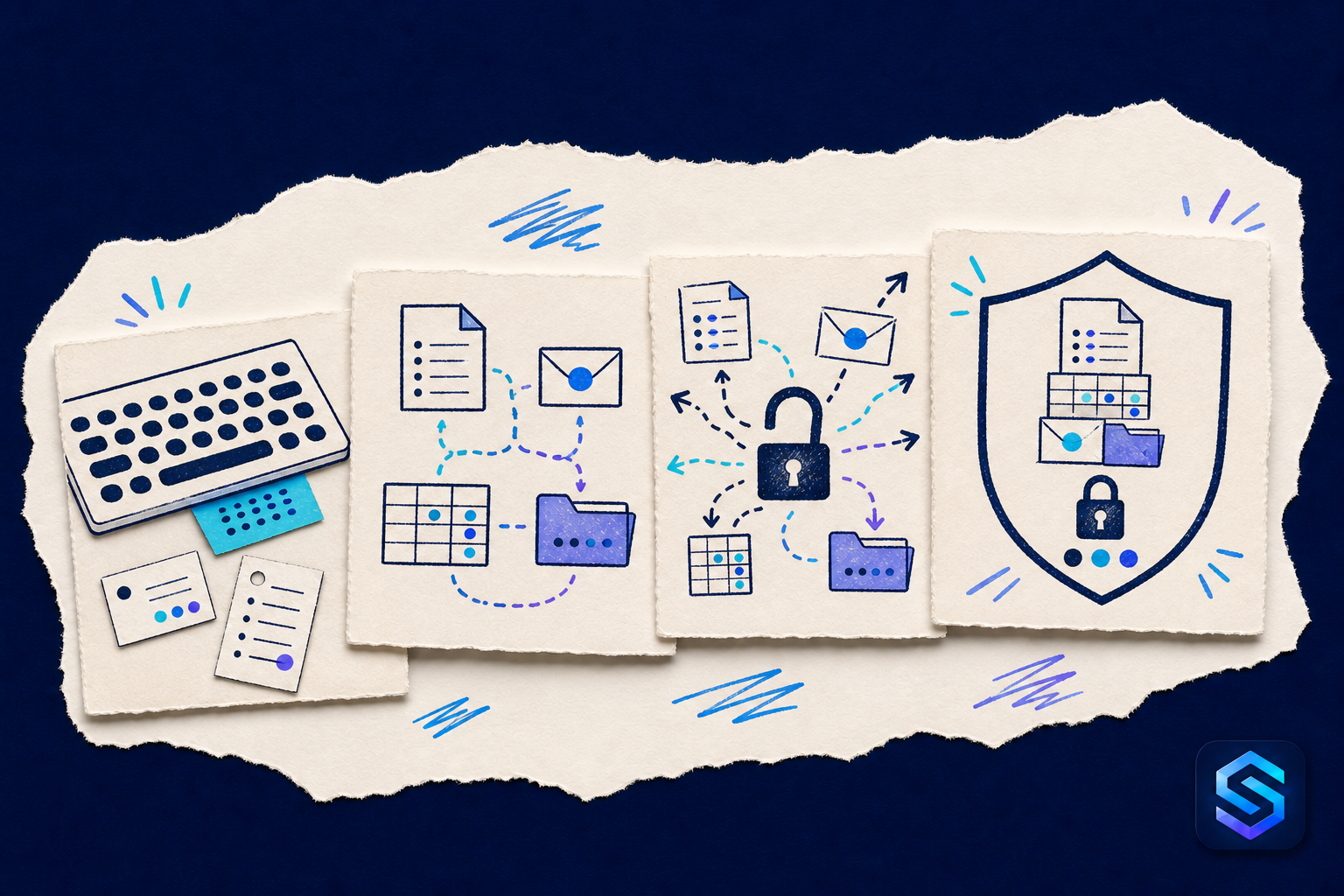
Every business depends on information.
Customer details, employee records, prices, schedules, passwords, payment information, and internal notes all help a business operate from one day to the next.
In a small business, that information is not always stored in a formal system. It may be written on a piece of paper, left on a business card, or placed under a keyboard as a reminder.
Computers have given us more places to keep it: spreadsheets, documents, emails, shared folders, and local computer drives.
These tools make information easier to save and retrieve. But they can also make it easier to forget where that information exists—and who may be able to see it.
Exposure Does Not Always Look Like an Attack
When we think about data security, we often imagine a skilled attacker attempting to break into a computer system.
The reality can be much simpler.
A customer waiting at the counter notices a password written near the keyboard. A colleague uses someone else’s computer to print a report and sees an open customer file. An email containing sensitive information is forwarded to the wrong person.
A shared folder may be available to every employee when only two people actually need it. A forgotten document may remain on an old computer. Malware that reaches one workstation may discover files stored across an entire shared drive.
None of these situations requires someone to defeat an advanced security system. The information was already accessible.
It was hiding in plain sight.
Not All Information Belongs Everywhere
Businesses collect different kinds of information, and some of it requires special care.
Customer contact details, employee information, contracts, financial records, and confidential business documents should only be accessible to people who need them for their work.
Passwords should not be written on notes or stored in ordinary documents. A proper password manager provides a more appropriate way to create, protect, and share credentials when necessary.
Payment-card information deserves even greater caution. A business should avoid storing card details unless there is a legitimate need and an appropriate, compliant process. Whenever possible, that responsibility should be handled through a qualified payment provider.
Before saving sensitive information, ask a simple question:
Does our business truly need to keep this—and, if it does, where does it belong?
Sometimes the safest information is the information you never stored.
Security Is a Daily Habit
Protecting information is not only the responsibility of an IT department or an outside specialist.
It is part of everyday business operations.
Taking a few additional minutes to store information correctly can prevent hours of investigation later. Locking a screen before walking away, using a password manager, limiting access to a shared folder, and securely destroying an unnecessary paper record may feel like small actions.
Together, those actions create a culture in which sensitive information is handled deliberately.
Security should not be viewed as wasted time or an unnecessary expense. The business is protecting information entrusted to it by customers, employees, partners, and suppliers.
That trust has real value.
Centralized Does Not Automatically Mean Secure
Moving business information into a centralized system is an important step, but centralization alone does not provide security.
A secure system must control who can enter, what each person can access, and what they are allowed to change. It should support strong authentication, appropriate permissions, activity history, reliable backups, and a plan for software updates and security incidents.
Employees should have access to the information they need to perform their responsibilities—without automatically receiving access to everything else.
This principle protects the business while also protecting employees. When responsibilities and permissions are clear, there is less uncertainty about who viewed, changed, or shared important information.
Current small-business guidance from NIST similarly recommends understanding what information employees can access, restricting sensitive information to those who need it, using multifactor authentication, and considering password managers. NIST Cybersecurity Framework 2.0 for Small Business
Convenience Should Not Remove Accountability
A system can be wonderfully convenient while still requiring proper controls.
Employees should not share accounts simply because it is faster. A password should not be placed under a keyboard because it is easier to remember. A complete customer list should not be copied to a personal drive merely because someone wants to work from home.
The convenient choice is not always the responsible choice.
This does not mean that security must make every task difficult. A well-designed system should make the secure action the natural action.
When protecting information feels unnecessarily complicated, the process should be improved. The answer is not to remove the protection.
Look at Your Business from the Outside
Business owners regularly review sales, expenses, staffing, and customer service. Information security deserves the same attention.
Walk through your workplace and look at it as a visitor might.
Can a customer waiting in the office see confidential information?
Are passwords or private notes visible near a workstation?
Could an employee copy the complete customer list even when their role does not require it?
Are sensitive documents scattered across inboxes, computers, shared folders, and portable drives?
Could someone using an unattended computer access years of business history?
Would you know if important information had been copied, changed, or deleted?
These questions are not accusations. They are opportunities to discover weaknesses before those weaknesses become incidents.
Protect What Others Have Entrusted to You
Information security is not achieved through a single product or one perfect decision.
It comes from knowing what information the business holds, deciding where it belongs, limiting access, training employees, and reviewing those decisions as the business changes.
A small improvement made today can prevent a much larger problem tomorrow.
Protecting sensitive information is a responsibility to your customers, your employees, and the future of your business.
If you can access that information without any form of security, someone else may be able to as well.
The payment-data guidance was also checked against the PCI Security Standards Council, which advises merchants not to retain card data they do not need and to use properly compliant payment providers. PCI SSC guidance for small merchants